
RESTOREID 2nd Annual Meeting Newsletter (Updates from 2025 and plans for 2026)
About a month ago, the RESTOREID consortium came together for our Annual Meeting. Two days of sharing, reflecting, and planning, that marked an important milestone: The project's halfway point.
Here’s an overview of where we stand and what comes next!
🎥 But before diving in, here is a quick refresher on what we do and why it matters:
Welcome to RESTOREID!
RESTOREID 2025 in Numbers:
In 2025, we accelerated large‑scale sampling, and we’re now moving from collection to interpretation.
- 89 restoration sites sampled across 7 countries
- Over 5.000 fly samples, vegetation swabs, soundscapes, and small‑mammal datasets are in the pipeline for analysis.
- Screening is underway; mechanistic tests kicked off at 3 locations.
- We piloted a metagenomic next‑generation sequencing (mNGS) workflow using CRISPR‑Cas9 enrichment to increase sensitivity for pathogen detection.
This is evidence base will help us understand how restoration alters biodiversity and disease dynamics, not in theory, but in real places with real communities.
But how does all this link with RESTOREID's overall strategy? Are we on track with the objectives we set at the beginning of the project? And do these numbers translate into real impact 🎯
Let's find out!
1. Better understand how restoration impacts both animals and people
Our first step was to clarify the relationship among land-use change, restoration, and zoonotic risk, not only for us but also for the broader science, policy, and socio-environmental ecosystem. Our progress included:
- Our global evidence synthesis on land-use change and zoonotic risk by Adam Fell, Soushieta Jagadesh, A. Bradley Duthie, Lucinda Kirkpatrick, and Nils Bunnefeld was published in Nature Sustainability.
- A policy review of more than 30 restoration policies has been completed, resulting in our first Policy Brief and a joint policy brief with Biodiversa+, which is currently in development.
- Mathematical scenarios are being developed to model restoration contexts and pathogen prevalence.
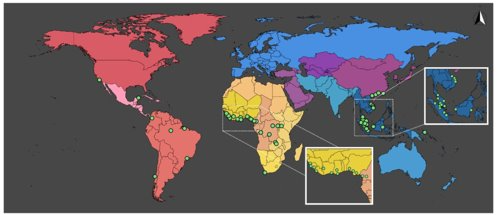
Mapping of the literature review
2. Explore how healthy, complex ecosystems shape disease risk and develop affordable and accessible tools and resources for it
If 2024–25 was about gathering information and designing methods, then 2026 is becoming the year those methods come alive:
- We published open protocols for acoustic and carrion fly sampling, making our methodology accessible to everyone.
- We also developed a prototype for an edge-computing acoustic detector. We are still working toward a more refined version, but the goal is to create a device capable of generating real-time insights, rather than the usual months-long delay between recording and analysis.
- Until then, we continue to refine acoustic soundscapes, explore structural complexity, and pair remote sensing with drone imagery. A change‑detection methodology is ready, country-by-country consultations are complete, and restoration timelines are clarified per site.
This work is setting the basis for better biodiversity–pathogen modelling.
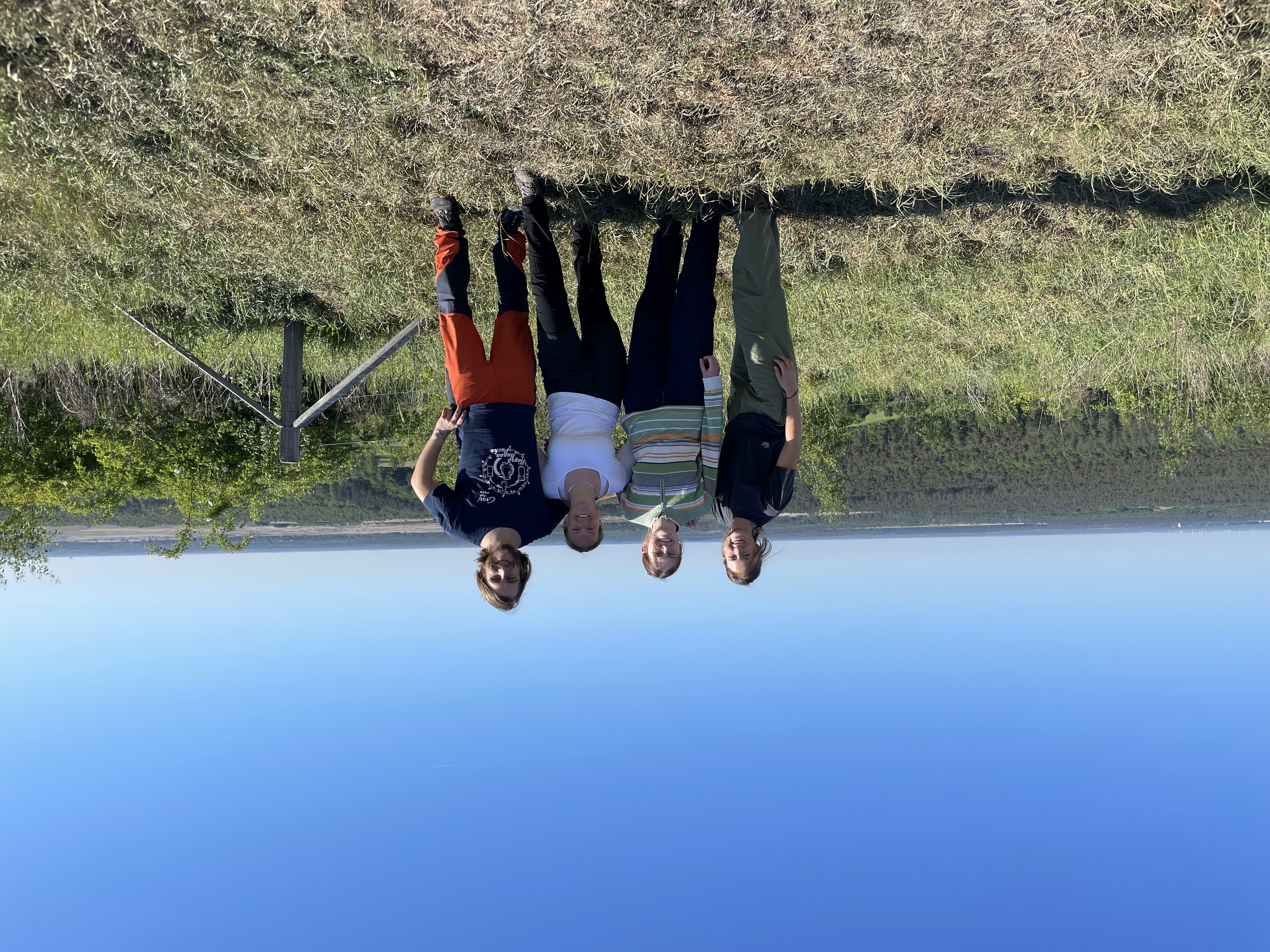
Belgium RESTOREID team during fieldwork - Picture by Marre van de Ven
3. Find out what the specific mechanisms are that drive diseases to jump from wildlife to people
To move beyond correlation, we’re conducting observational and experimental tests:
- Scotland: RFID tracking, eDNA, soundscapes, camera traps
- Tanzania: Capture‑mark‑recapture + acoustics
- Finland: Controlled fence experiments underway
We've defined a mechanistic model structure; simulations are running, and a Bayesian belief model is under development to integrate all the input on ecology, behaviour, and pathogen dynamics. Mechanistic tests will be completed this year across Finland, Scotland, and Tanzania.
All this mechanism‑driven evidence is what lets us recommend which restoration actions reduce risk, and where.
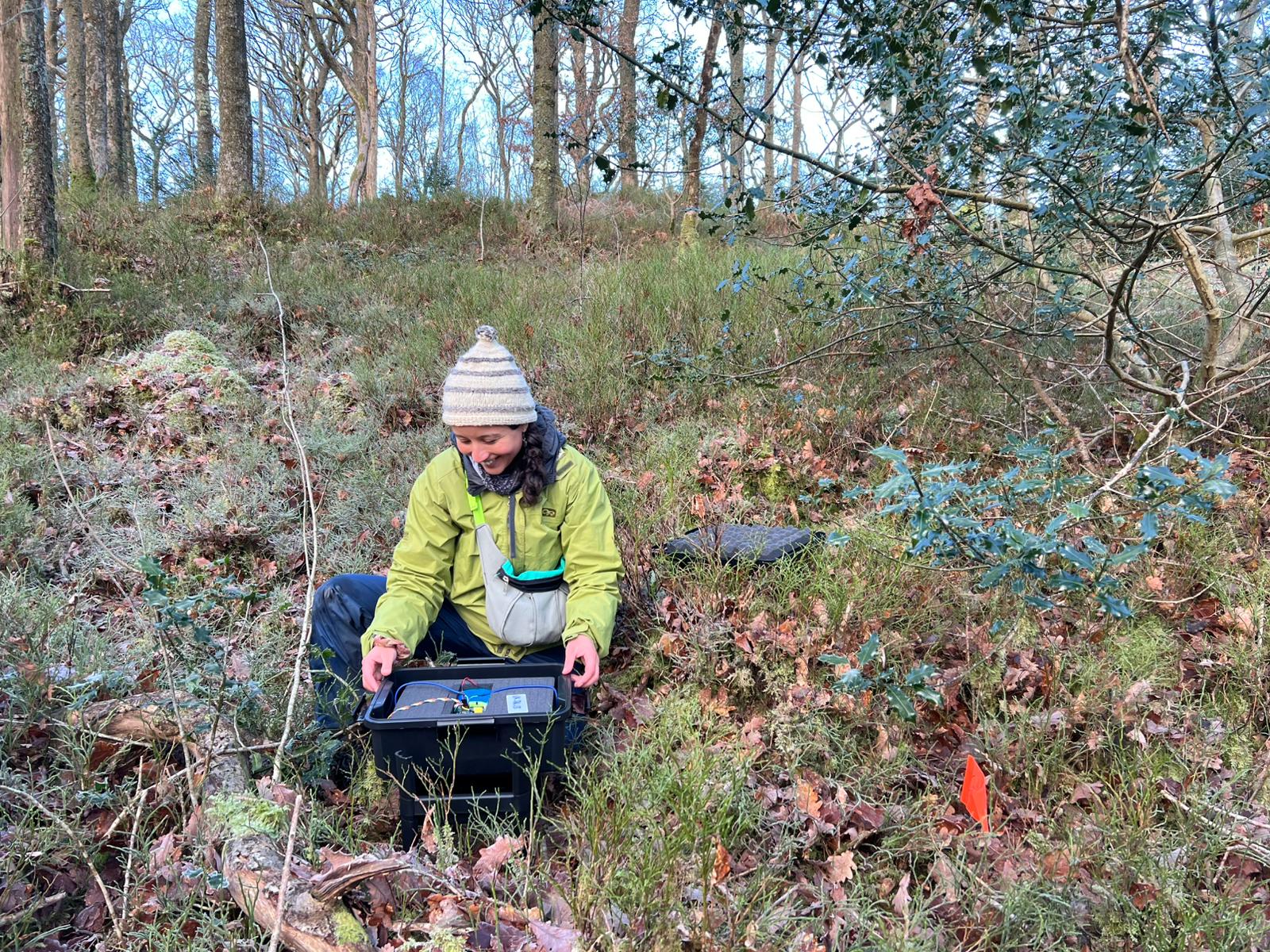
RESTOREID Fieldwork in Scotland - María José López Jara
4. Work with communities to understand how social and economic realities shape successful ecosystem restoration
We co‑designed and tested our mobile restoration game (developed by GLITCHERS with Nils Bunnefeld & A. Bradley Duthie). After early analytics from 69 players (~800 decisions/player) we identified three gameplay profiles:
- Restoration‑focused 🌱
- Farming‑focused 🚜
- Landscape‑clearing / destructive 🔥
Which one are you? Play and find out here 👉 Restore 👈
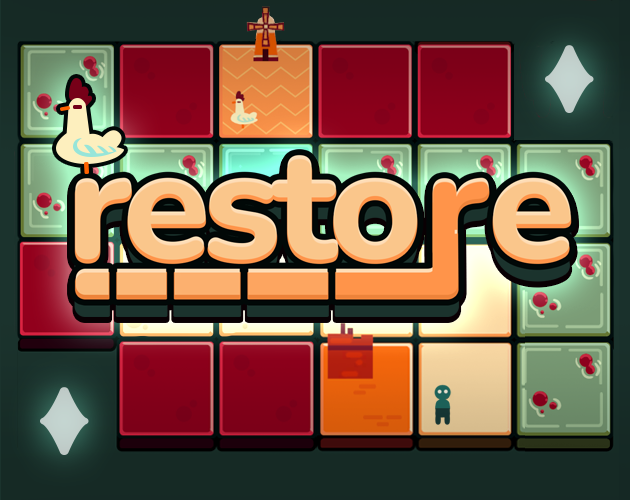
Restore game
Meanwhile, we’ve completed 59 expert interviews for an expert elicitation on land use, restoration, and zoonotic risk, progressed ethnographic work (Belgium, DRC), advanced survey piloting (Scotland), and developed and trialed protocols in Tanzania.
Key data from both the game and surveys will feed into our upcoming Decision Support Tool, so that, once it's available, it accurately reflects the choices people really face.
5. Strengthen collaboration and knowledge exchange to stop diseases before they emerge
Knowledge only creates impact when it circulates, and in 2025, we took major steps to help build the broader support system needed to link restoration, biodiversity, and disease prevention.
- Together with the ZOE Project Horizon Europe, Alternet, and others, we conducted a large-scale needs assessment to guide the creation of a shared Knowledge Exchange Network (KEN). More than 370 people responded to our survey, followed by focus groups that helped identify community needs, gaps, and priorities.
- One direct outcome of this work is the RESTOREID Initiative Library, a central hub that brings together key tools, projects, repositories, and evidence resources so they don’t get lost in the noise.
- Our work and efforts are now focused on supporting BioAgora Project’s development of the Health & Restoration KEN, ensuring RESTOREID’s work inform a larger and coordinated European knowledge‑sharing system. We’re also working with them on a joint policy brief to help translate these insights into action.
If you want to learn more about all these results, check out our website to access our deliverables, full list of scientific publications, and latest blog posts breaking down our insights and findings.
What’s next in 2026: integration, prototypes, and public tools
Our main scientific challenge and opportunity this year is data synthesis & integration: pulling biodiversity, pathogen, socio‑economic, and remote‑sensing layers into a consistent analytical fabric. We have already made good progress on this, but by the end of the year, we will have:
- Completed Phase‑1 sampling and publish finalised protocols
- Delivered an edge‑enabled Passive Acoustic Monitor prototype
- Finished mechanistic tests and run theoretical model simulations
- Launched socio‑economic surveys at priority sites and extend expert elicitation
- Driven cross‑work‑package synthesis to feed the Decision Support Tool and policy briefs
Come say hi! 👋 Where to find us next 👉
If you want to connect in person, we’ll be sharing results, running workshops, and connecting with partners at:
- World Biodiversity Forum (Davos, 14–19 June) — three sessions, including a live workshop of the Restore game!
- Pathways Conference (Oxford, 14–17 June)
- European Congress of Conservation Biology (Leiden, 6–10 July) — with BEPREP-eu
- Global One Health Congress (Lisbon, 4–7 September) — joint presence with BCOMING, BEPREP-eu, ZOE Project Horizon Europe
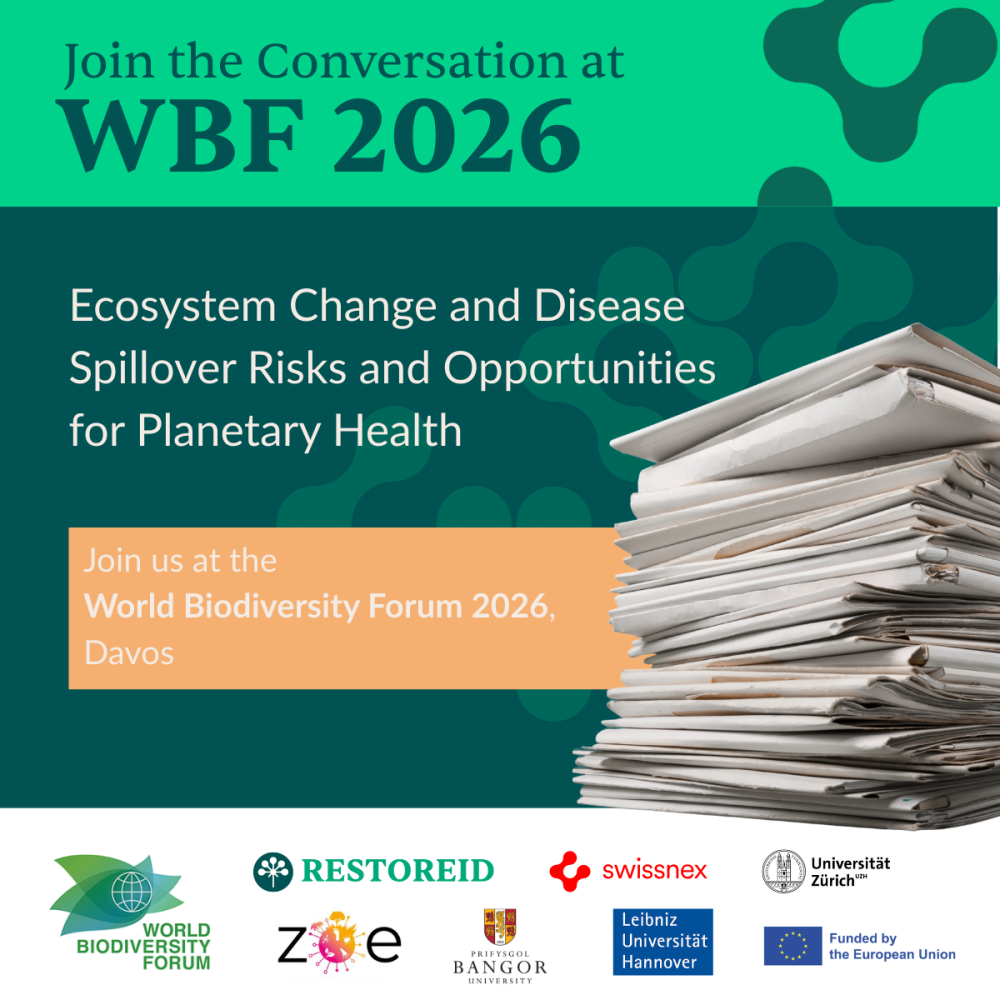
Announcement of the joint session at WBF 2026
That is all from us — for now!
After a productive 2025 and an even more ambitious 2026 on the horizon, we won’t be away for long. ✨
Thank you for following our journey toward healthier ecosystems and reduced disease risks. We’re excited to continue sharing what we learn along the way.
Until the next time,
The RESTOREID Team
RESTOREID is funded by the European Union. Views and opinions expressed are those of the authors only and do not necessarily reflect those of the European Union or the granting authority. Neither the European Union nor the granting authority can be held responsible for them.